Your Observation-Based Assessment (OBA) is the behavioral picture of you that emerged from structured interviews with your 360 team. Here's how to read it, what to look for, and how to turn what you find into your next move.
Page 3 of your report is a one-page visual summary of what your sponsors said — before any narrative. Read it first to spot the patterns, then dive into the Executive Summary for context.
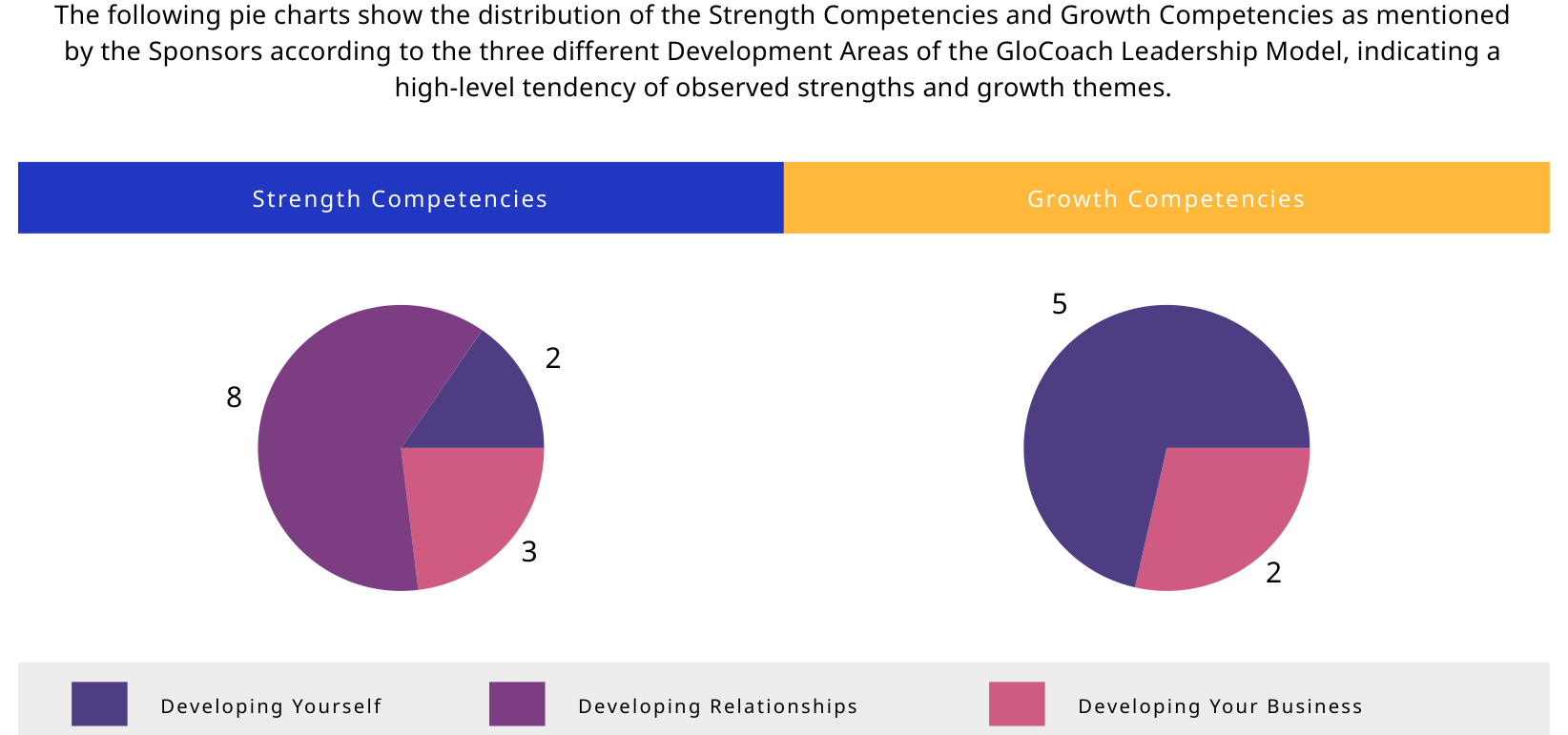
The GloCoach Leadership Model groups all 32 competencies into three Development Areas. Your pie charts show how your strengths and growth areas distribute across them — the high-level shape of where you operate today, and where the next chapter is pointing.
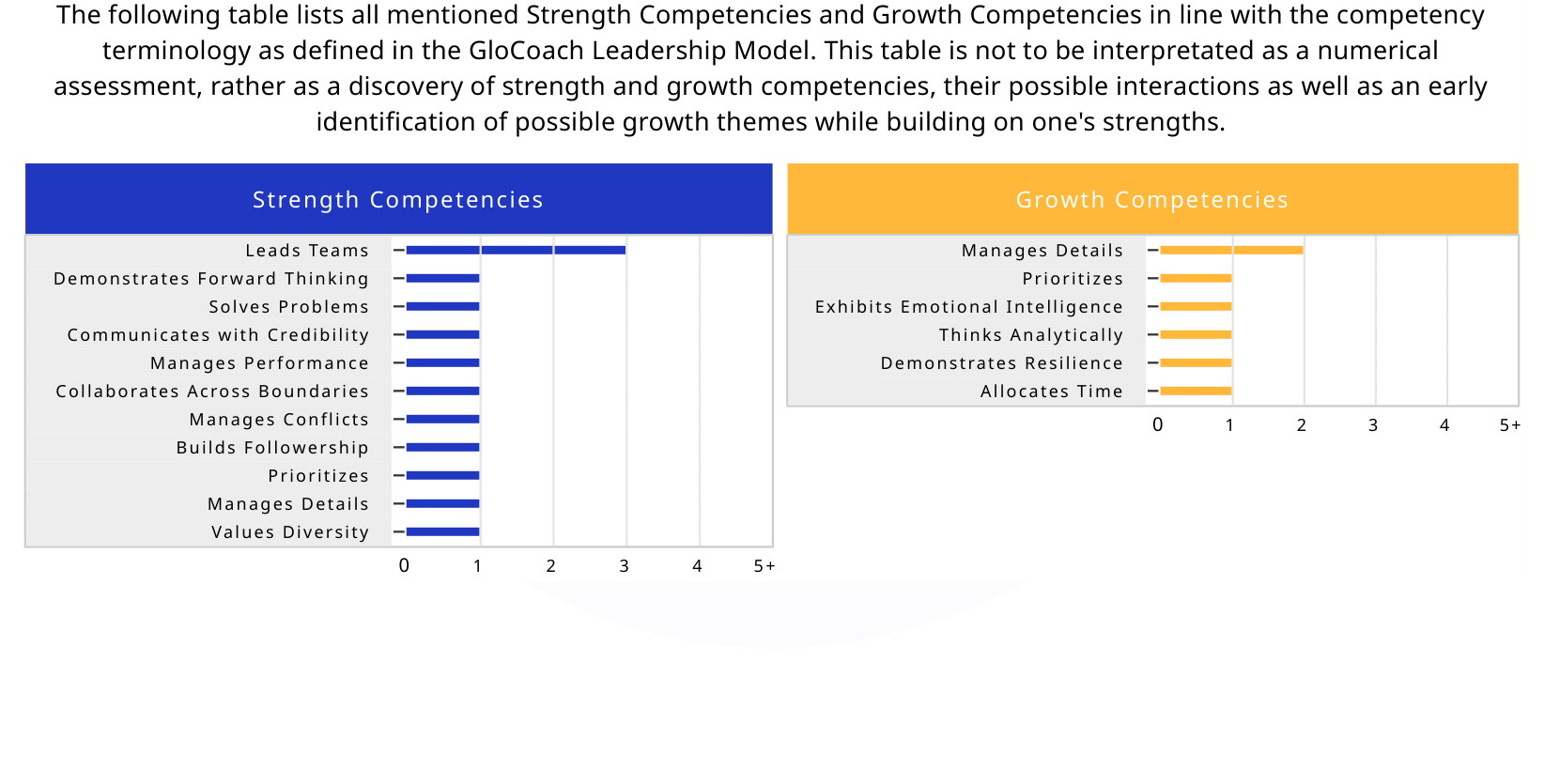
Each bar represents one of the 32 competencies in the GloCoach Leadership Model. The bar's length is the number of sponsors who independently raised that competency in their interview — not a rating or a score.
Different lengths mean different levels of agreement. A competency at 2 or 3 mentions was raised by multiple people from different vantage points — that's a real pattern. A competency at 1 mention is one person's view: still useful, but a single data point.
After the overview, these three sections are where the real signal lives, in this order.
The narrative of what your sponsors actually said about your strengths and growth areas, in their own words.
This is where the patterns emerge. Don't just skim it. Read for the THEMES that repeat across multiple sponsors, not the individual phrases.
GloCoach's distilled view of your top 3 priority development competencies, drawn from sponsor feedback and your own Personal Discovery.
This is where insight becomes action. These are the levers that will most accelerate your next leadership step, not a generic to-do list.
Areas that need careful attention: sensitive themes, blind spots, and patterns that deserve a real conversation rather than a quick fix.
These aren't "negatives." They're high-leverage growth opportunities, and often the most consequential part of your development journey.
The Value Insights section opens with a four-quadrant chart and a marker called CoG. Both look simple, but they encode the most important orientation question in the report: what your values are pointing you toward, and how you live them out.
Every value you select gets placed by two questions. Together they sort 96 values into four orientations.
Vertical axis — OUTCOME (why these values matter to you): Business outcomes (top) or personal growth (Self, bottom).
Horizontal axis — PATH (how you live them out): Through your own effort (Self, left) or through other people (Relationships, right).
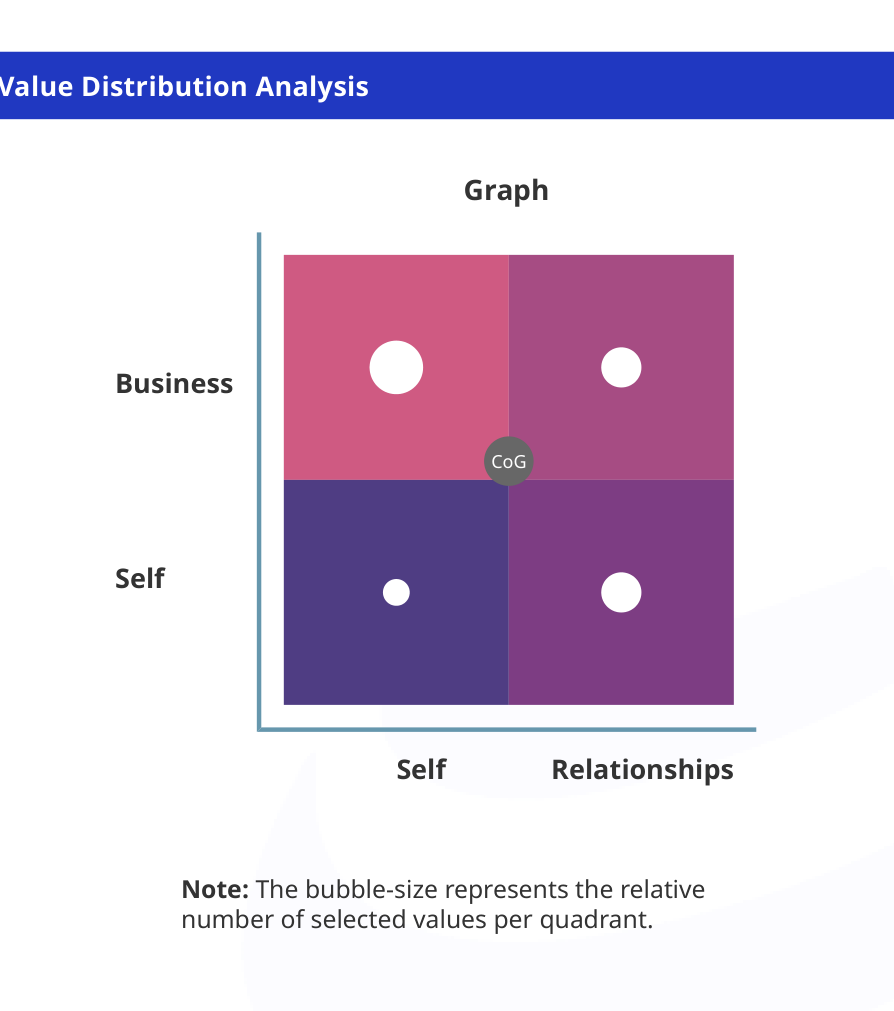
Bigger bubble = stronger pull in that direction. A balanced chart means your values draw on multiple modes; a chart concentrated in one quadrant means you have a clear, dominant orientation.
CoG is the weighted middle of all four bubbles — one point that captures where your values sit overall. Top-heavy means business-driven; bottom-heavy means growth-driven. Right-leaning means you rely on relationships; left-leaning means you rely on self. Near the centre means balanced.
This is the chart as it appears on page 11 of a sample OBA report. Same two axes, same four quadrants, same CoG marker — just without the quadrant labels we added above to teach the framework.
In this example, the talent's values sit slightly toward Business (top-heavy) with a CoG that bridges Self and Relationships — signalling someone who drives outcomes by drawing on both personal discipline and other people roughly equally.
The OBA isn't just a report to scan. The most useful parts are easy to skim past. Here's where to slow down.
Under each strength, your report cites the specific moments your sponsors saw it happen — direct quotes, behaviour examples, situations. Don't just see the bolded competency name. Read the verbatim quotes.
The competency name tells you what sponsors named. The evidence tells you how your strength actually shows up in practice — in the language of the people who work with you. That's what makes it real.
Inside the Recommendation section, the report describes "ideal behaviors" for each priority competency — concrete actions, not abstract development goals. These are starter moves you can practice tomorrow.
"Improve your delegation" is vague. "Delegate ownership of one team meeting per week to a direct report" is actionable. Ideal behaviors are written at the actionable level. They're the bridge between insight and habit.
Don't try to act on all three priority competencies at once. Pick the one that resonates most — the one you'd already been thinking about before reading the report — and turn it into a single concrete move.
The OBA's value is realized when it changes what you do, not when you finish reading it. One small, specific commitment beats three vague aspirations every time.
Before you close the report, pause. The OBA only becomes useful when you decide what to do with it. These two questions are the difference between reading and integrating.
Not three takeaways. Not a summary. One — the thing that landed hardest, surprised you most, or kept coming back as you read.
Be specific. Which conversation, project, habit, or relationship will look different because of what you just read? When? With whom?